Monday, 28 October 2013

Watching Windows

I'm continuing to work on the wheelhouse interior.  However, I had decided to try to get the wheelhouse outside finished and painted before the weather turns too cold to spray paint.  Not sure whether that'll happen in time!

So, I turned to the flybridge windscreen.  The three pieces were soldered together using my 'helping hands', square and graph paper to measure the correct angles.

I then made the the inner frames from 0.5mm styrene.  These will get bolt heads too but I'm holding off for the time being and will explain all next time.

Building the windscreen has also highlighted a few issues with the top of the wheelhouse door.  So I'm rebuilding that at the same time.  Essentially. the build up on the cabin roof needs to be lowered, but here's the work in progress.


Monday, 30 September 2013

Complete Control

This time I've been making controls for the wheelhouse and the flying bridge.  I've made the steering control, new throttle levers and the SIMS control.

The steering controls are on the helm and cox's seat and also to the port of the flying bridge.  The body is 3.2mm and 4.8mm styrene tube and the lever 0.8mm and 1.6mm brass/alloy.

As there are more throttle controls than supplied in the kit, I made a new set so that they are uniform.  The body is laminated discs of styrene made using my punch tool, through which is a 1.6mm alloy tube.  The throttle levers are dressmakers pins.  These are on the helm and cox's seats and on both sides of the flying bridge.

The SIMS controls are 2 pieces of 3.2x6.4mm styrene glued together then cut and sanded to shape.  The trackballs are dressmakers pins.  These go on the Helm, Cox, Mechanic and 1st Navigator's seats with a 5th on the 2nd Navigator's table.


Now, just to paint them.

Sunday, 15 September 2013

Stairway to Heaven

This time it's the turn of the stairs.  Model Slipway have been excellent in supplying a few extra bits and pices for my build and allowed me to buy extra bits and pieces without having to buy whole photo etched frets.  That's allowed me to get a second set of steps back down into the cabin.

Is used my etch-mate tool to fold the steps though it was harder than I expected.  Due the shape of the outside pieces, I used a combination of the etch-mate and a pair of long pliers.  The pieces we re then soldered together by soldering all steps to one of the outside pieces first using a square to make sure all were, well, square!  The other pieces was then soldered on.

The photo below shows both sets of stairs finished.  One set has 0.5 styrene inserts on each side.  This was used to join the bottom step back on that I'd previously cut off.  This was originally cut off to fit the cabin as per the kit design.  However, as I wrote in my 11 & 28 January '13 posts, I dropped the cabin floor.  Luckily, I'd kept the unused bottom step and the pieces of the side parts that I'd cut off.  This set will go inside the cabin so the repair shouldn't be too obvious!


Saturday, 24 August 2013

Too Hot to Handle

Right, this build is going much slower than I'd planned.  It's really down to the number of modifications I keep making!  Some of the mods I think will be straightforward are taking more time than I thought and the various handles are a case in point.

I decided that the white metal handles with integral bases were not really as good as I would like.  Especially when compared with the etched metal bases and wire versions from the Trent kit.  Don't get me wrong, I understand MS need to keep the cost of the kit down, so some compromises are necessary.

One thing to note, is that the handles seem to vary a little from boat to boat and from the RNLI plans.  I didn't have enough photos of the Padstow boat I'm modelling, so have had to take a guess based on other photos I have from the early Tamar boats.

The handles were all made from 2mm brass rod, save for on the escape hatch, which was 1.6mm.  The bases were made from 0.5 mm styrene; either discs cut with my punch or from 3.2mm strip.  Again the escape hatch was an exception using etched parts from the Trent kit.  What took the time was accurately drilling the holes in the bases and filing them to accept some of the handles.


Going clockwise around both photos from top left, the handles are:
The original kit part,
the stern locker
the flying bridge to the helm's left
To the port of the wheelhouse door
to the starboard of the escape hatch
for the escape hatch
on top of the port engine vent, and
above the wheelhouse door.

The may have taken some time, but I'm please with the results.  Now, what's next?

Sunday, 28 July 2013

Debaser

It's no wonder this build is taking longer than I planned when I go and do things like this.  For a variety of reasons I've remade all of the seat bases in the cabin.

First, I somehow lost one of the bases and I didn't want to stretch the kindness of Model Slipway again in trying to get spare parts.  Secondly, I'd not sanded all of the bases to the same size when cleaning up the excess plastic from the vac form and I felt there was no guarantee I'd get it right a second time.

As the new bases would be higher than the kit parts, they should also look better due to the lowering of the cabin floor.  Finally, where I've modified the seats, the frames are slightly different widths to the dimples on the kit parts which had made drilling the holes tricky.

The first job was to mark out the parts on 1mm styrene sheet.  This pic shows this, there's 10 parts per base.

I built the bases in two parts; the seat base itself and the lower foot rest.  The backs of the seat bases have rounded corners so I glued 3mm square rod inside the join and then sanded the corners round.  I then joined the two parts together.  This pic shows all the bases temporarily in position, with a kit part for comparison.

Next job is to drill the holes for the seat frames and the damper.  The seats still need some work as well.

Monday, 1 July 2013

Up The Bracket

This time, I've been working on the brackets on the stern for the transom door hinges and trim tabs, and the door hinges themselves.  Big thanks must agin go to my mate with a milling machine who made up the basic parts.  These are shown in the first photo below.  The hinges are made from brass strip soldered together whereas the brackets are milled from a block of brass.

Then it was over to me to shape the parts, for which I broke out the cutting disc on my Dremel and various files.  I'm really pleased with the results which will hopefully give a strong working hinge without being too over scale.

Now, I need to get me head around mounting the servo to operate the door and designing the servo linkage and dummy hydraulic rams.

Monday, 17 June 2013

Reel Gone Kid

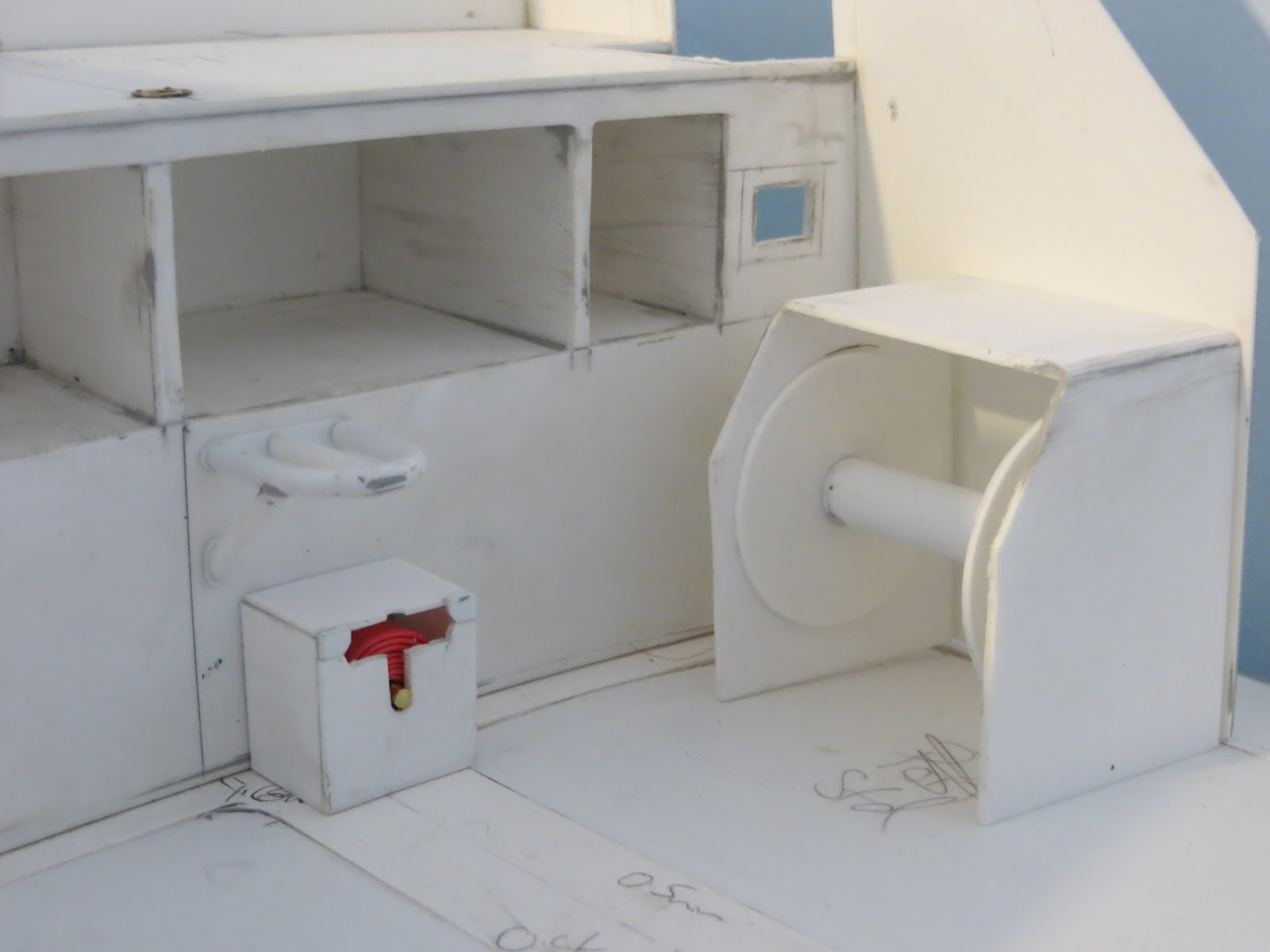
This time, I've been working on the back of the wheelhouse, trying to finish of the various storage boxes and vent housings that I'd started ages ago.  Some of the boxes have warped slightly so I added squares aof styrene inside to sqaure them up.

I've also added som detail to the hose reel  and tow rope boxes.  The component parts are below;
I've made a reel for the tow rope, which will be the appropriate size blind cord added after painting.  Small slices or tube were glued inside the box to add as a location of the reel and allow the box and reel to be pained separately.  The fire hose box has been slightly modified around the lid and a hose reel added.  The hose is heatshrink tube superglued to a 2.4mm brass rod.  The 'guard above the hose reel box is 2.4mm styrene tube with 0.5mm styrene strip where it joins the wheelhouse.  I've also made backing plates for all of the boxes in this area.  These will be fitted before painting and will hopefully allow the boxes to be painted separately from the wheelhouse but still allowing a positive fix.  Anyway, this shows the reel boxes in place; more next time.